

Why Does My Well Draw Down So Much?
Similar any resource, well h2o can run out if not monitored and managed correctly. It'southward unlikely a well will permanently run out of h2o. Even so, there are nine things to consider that can crusade your well h2o to reduce or get dry. This is a big post and is one of my favorite topics, and so let's go started.
Well h2o will run out if the groundwater level drops below the water intake depth. This tin be caused by natural or man-made variations in groundwater acme including reduced precipitation, slow groundwater recharge, well infill, high water usage, well drawdown or hydrofracking.
In this mail, I'll get into a lot more detail on the main reasons wells can run dry. I've as well added in lots of diagrams to help make it easier to understand whats actually going on clandestine and how it affects your well.
Ok, my background is in groundwater. I've worked on some pretty absurd groundwater enquiry projects and even developed groundwater monitoring programs for mining companies. Aye, that's me in the picture beneath – looking like a complete nerd while dipping a 300 foot deep well.

I'll try non to get too bogged downward with too much of the science and make it applicable to your needs – for both commercial and private wells (domestic wells).
Information technology is super of import to know what is going on with your well water, what causes it to dry up, and what y'all tin can practise most information technology. And then let's get into it.
Here are the 9 reasons well water can run out:
one. Reduced precipitation
The h2o y'all go from a well has to come from somewhere right?
A reduction in the amount of precipitation (usually in your surrounding surface area) ways at that place is less water available to make it to the groundwater organization. This will in plough reduce the corporeality of water reaching your well.
Precipitation includes:
- Rain (obviously)
- Sleet
- Drizzle
- Hail
- Snow
- Small ice pellets
Fog and mist that condenses on plants or on the ground can also contribute to groundwater. Although they are technically not forms of precipitation, they still help continue the ground moist which in turn helps reduce evaporation.
What you lot often discover is there can be a lag betwixt a period of reduced precipitation and your well water level dropping or even drying up completely. Some aquifers can be in tune with the local precipitation patterns, while others barely even reply to a dry period.
ii. Reduced groundwater recharge
Ok, and so recharge is basically the corporeality of water that makes its way from the earths surface into the groundwater system. I know recharge sounds like the same thing as atmospheric precipitation, but at that place are many things that tin influence what happens to all that water once information technology hits the ground earlier "recharging" the groundwater (including aquifers).
Some of these include:
Evaporation
High evaporation can seriously reduce the corporeality of water reaching the groundwater organization. Essentially, the more than time water spends close to the surface the longer it tin evaporate, which reduces groundwater recharge.
Temperature
This is pretty obvious, but high temperatures ways college evaporation and reduced groundwater recharge. If you live in an expanse that is dry out and hot, it's going to take a whole lot of rain to make its style down through the soil and into an aquifer.
Air current speed
This is a big i! High wind speed works by increasing evaporation and reducing the amount of water available for infiltration. High winds quickly wicks away evaporated water and allows for continual evaporation. It's just like how your clothes dry out faster on a windy 24-hour interval compared to when it'southward still.
Vegetation alter
Vegetation works in many different ways that aids in groundwater recharge. Here's just a few:
- Reduces evaporation – more than trees, ground cover and organic thing on the surface reduces evaporation.
- Reduces sunlight and heating of the earth – obviously it's shadier under a tree. But did you know that plants blot specific wavelengths of low-cal that are hotter than those that it reflects. This is why you are cooler continuing under a tree than just under an umbrella. When the ground is cooler, less water evaporates and more migrates downward recharging the groundwater.
- Increases infiltration – Expressionless plant roots, peculiarly deep tap-rooted copse, create passageways for water to quickly migrate downwardly through the soil and recharge the groundwater.
- Copse are cracking strippers! As cloud, fog or mist moves through a forested surface area they can "cloud strip" a TON of water. Some is used past the plants, just a lot permeates downward into the soil recharging the groundwater.
I'll stop in that location, only I think you get the point. Plants enhance groundwater recharge which has a flow on outcome to how much water is in your well.
Relative humidity
This relates to the amount of moisture that is already in the air and how it affects how quickly evaporation takes place. If the air surrounding surface water or wet soil is very dry out (does not contain wet itself) then groundwater recharge will be reduced. In comparison, if the air is already saturated with water vapor then yous will get greater downwardly movement of h2o and groundwater recharge.
Water table depth
A shallow water table (i.due east. inside almost ten feet of the surface) means the groundwater tin continually evaporate from the soil profile and therefore reduces the amount that tin movement down into the groundwater organization. Insufficiently, a deep water table may take longer to recharge but will non exist affected by evaporation.
Soil type
In general, sandy soils allow faster downwardly movement of water and recharge. Rocky or heavy clay soils concur water about the surface and for longer, increasing evaporation and reducing recharge.
3. Well infill
Wells often infill with loose sediment over time. This can lead to reduced menstruation or it tin stop your well producing water entirely.
When a well is installed, a casing of PVC is usually (not always) used downwardly the length of the hole. At sure sections forth the well casing in that location are screened sections. Depending on how deep the well is or how many aquifers are intercepted, at that place could be just one screened section or in that location may be multiple.
Screened well sections basically let h2o to passively flow from the surrounding aquifer into the well. Without these screened sections, little to no water would enter your well.
Over time, loose textile can motion through these screens reducing the amount of water available in your well. This could take years or even decades to occur. Or, if you're unlucky it can happen almost instantaneously and all of a sudden y'all tin't go any more h2o from your well.
For this reason:
I always suggest people regularly check their WELL depth.
NOT Simply H2o DEPTH.
This mode you can tell if your well is gradually infilling or if in that location are any obvious blockages that might exist stopping/reducing the period of water into your well.
I would recommend getting your own water level meter (well dipper).


This is a really squeamish dipper that'southward available on Amazon. In fact it's the same brand and very like to the i I'm using in the picture at the top of this post. Click the photo to see information technology on Amazon.
It measures well water depth via an indicator calorie-free and aural beep. Yous adjust the sensitivity to be sure your recording the water level and not merely a dingy lesser. This unit of measurement also allows you to easily collect drawdown information to calculate how productive your well is! Perfect! It can also be used to record full water depth only by letting it drop to the lesser. Just remember to get one long enough to reach the bottom of your well and don't forget to plow off the water monitor sensor otherwise y'all will be listening to a deafeningly loud beep as you lot drop information technology all the style down to the well bottom!
A cheaper pick for monitoring well infill is by measuring full well depth (not the water level) using a surveyors tape.


Yous'll demand i with steel bract tape (typically nylon reinforced) as you have to add together a heavy weight and then it tin reach the bottom. A regular nylon record measure can stretch giving yous inaccurate readings or break. Click on the photograph in a higher place to encounter my recommendation for a good surveyors tape on Amazon.
iv. Loftier water usage
So this is going to sound kind of obvious.
Don't use too much h2o or your well may run out.
Many people ask questions such as:
- How long tin can yous run your hose on a well?
- How many years does a h2o well last?
The truth is… It depends.
It can depend on:
- What rock/soil type you have
- If the water comes from an aquifer
- What type of aquifer(due south) you have – perched, unconfined, confined, leaky.
- How deep your well is
- How many wells you or your neighbors have
- AND… Of course…. HOW MUCH H2o YOU ARE USING
There are many factors that tin influence how long a well lasts. Withal, Yous Tin can CONTROL how much h2o y'all utilise and it'due south definitely something you should monitor, specially if y'all've had problems with your well water running out in the past.
When a well is installed, normally a "pump exam" is completed. If you didn't get i you can get a professional person out to exercise a pump test for you.
A pump test is actually a serial of tests completed over fourth dimension. The well water will be pumped out at varying rates and compared against the water level in the well. From this you can work out how "productive" your well is and how much h2o y'all can apply before it becomes "unproductive".
The trouble is, a pump test simply provides a snap shot of the well'due south production at the time of the test. Things can change. Information technology can often be a skillful idea to get a pump test washed at to the lowest degree twice. Once in spring and once in the fall (or once in summer and once in winter). This way y'all tin accommodate your water usage according to the season.
5. Slow aquifer recharge
The water from your well is not endless and the rate of recharge tin can vary greatly between aquifers and through time.
In truth, no one on this planet really knows what is going on underground as it relates to aquifer recharge.
Determining if an aquifer recharges slowly or apace generally comes down to how fast or deadening you lot can pump h2o without the well water level dropping. However, this gives you no information on how much water is in an aquifer or how long it took to go at that place.
Some aquifers can accept 10's of thousands of years to fill, just can go depleted in just a few. i.e. Yous may non have had any issues with your well for years, but through pumping and the passage of time your well could brainstorm to run dry.
The water in your well can return even with a slowly recharging aquifer, merely sometimes it can have longer (or a lot longer) than what nosotros would similar it to.
In that location is non much you tin do to "ready" an aquifer that recharges slowly.
Nevertheless, a few options include:
- Digging a new well – hopefully into a unlike and faster recharging aquifer.
- Digging your existing well deeper – once again hoping to reach a different aquifer that is hopefully faster recharging.
- Hydrofracking – run across bottom of this mail service for more details.
six. Artesian well water drying up
Many people inquire: Practise artesian wells run dry?
I'll tell you a cute story about my mom.
My honey old mom uses well water, mainly for her garden. She'southward 73 year quondam and lives by a river that's close to the ocean. Her well is quite shallow and is on sandy alluvium (sand derived from the river). She was telling me all about how she recently got someone around to prepare the pump.
She said "one time it's fixed the water will never run out as it's artesian h2o".
Cute… merely not exactly correct.
I had to politely explain she was not in an area that had artesian h2o, and that her well water comes from groundwater that moves through an unconfined aquifer (the sandy alluvium). I also had to explain that even if it was artesian water it could nonetheless run out.
She was a trivial unimpressed.
However, it's a mutual mistake people often brand.
Artesian water is essentially water that comes from a confined aquifer, pregnant it has a relatively impermeable layer higher up it (and usually below it) stopping the h2o from hands getting to the surface. Once you lot drill down through this top circumscribed layer, you can access the artesian water.
Artesian can mean the water is under pressure. In some areas, water can literally spout out of the top. Otherwise, y'all often don't need to pump the water from bang-up depths, making artesion wells a bit cheaper to run (less utility costs).
Just… Artesian wells tin can withal run out of h2o.
The "force per unit area" in an artesian well comes from a pressure gradient in the groundwater (called the piezometric level or hydraulic caput).
How this works is the same as filling a piece of garden hose with water. Imagine belongings a short piece of hose with the two ends facing up (loop at the bottom). You fill it with h2o – What happens?
Nothing! The water but sits in the tube right.
But, what if you put your thumbs over both openings, lifted 1 finish higher and then took both thumbs off – What happens to the water now?
The water comes pouring out the lower end.
Congratulations yous simply replicated flowing artesian water coming out of well.
In the real world, let's say your well was located near the base of operations of a mount:
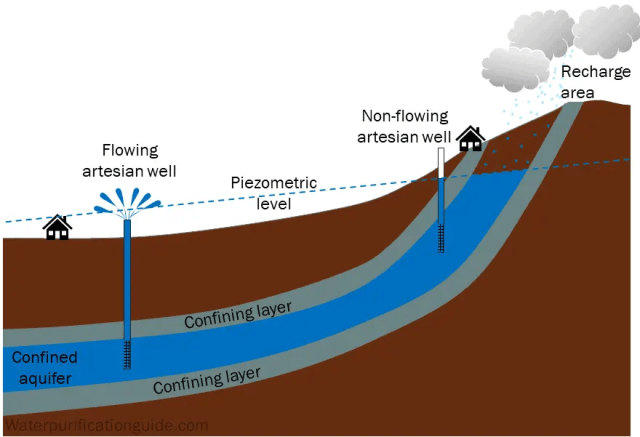
Atmospheric precipitation recharge occurs on the mountains, which migrates betwixt two confining layers deep hush-hush. Depending on where your well is located and the height of the piezometric water level will determine if your artesian well flows or not.
All it takes is a reduction in the piezometric water level (hydraulic caput) for your well to stop flowing and can fifty-fifty run dry. This can be caused by reduced recharge or just from high h2o apply.
In the epitome above, the house on the right shows a non-flowing artesian well from a reduced piezometric water level.
vii. Lowered water table
So far I've only discussed natural reasons for a change in groundwater height, excluding high h2o usage.
In truth, the water table tin very easily be lowered when in that location are multiple wells in a given area or if one person has a high water usage – typically on a commercial belongings such as a farmer using the water for irrigation.
Ok, lets pretend y'all have a well that is producing lots of water. Everything is going swimmingly – pun intended.
Then comes along a new neighbor who puts in their ain well, and and then some other neighbour increases their employ… etc.
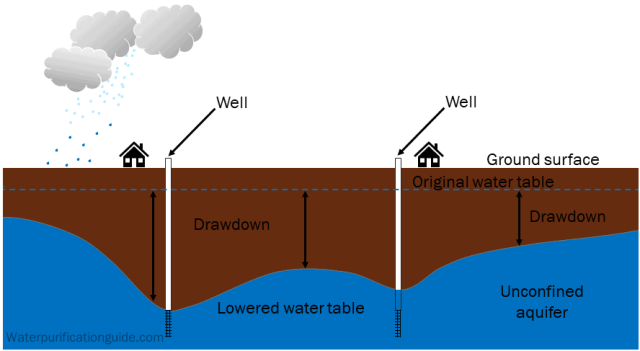
Soon enough, you may find your well is not producing anywhere near as much water as information technology used to. What's most likely happening is the water table, also called the static water level, is being lowered from too many wells and high usage.
The more wells pumping groundwater means greater need on the resource, which tin can cause your well to dry.
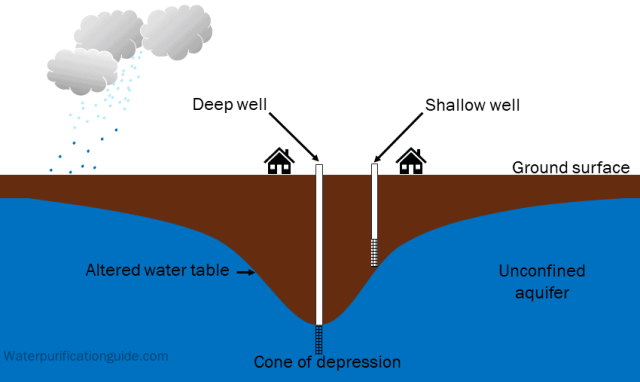
viii. Drawdown and the Cone of Low
This may audio like a title to a REALLY BAD movie. But… information technology's very existent.
A cone of depression refers to the shape of groundwater immediately surrounding a well. As water is existence pumped up, the groundwater around the well becomes depleted and takes on a cone-shape that radiates outwards from the intake.
Drawdown is the divergence between the original h2o tabular array depth (without well pumping) and the cone of low groundwater depth (with well pumping). The drawdown will be greater closest to the well and least uttermost from the well.
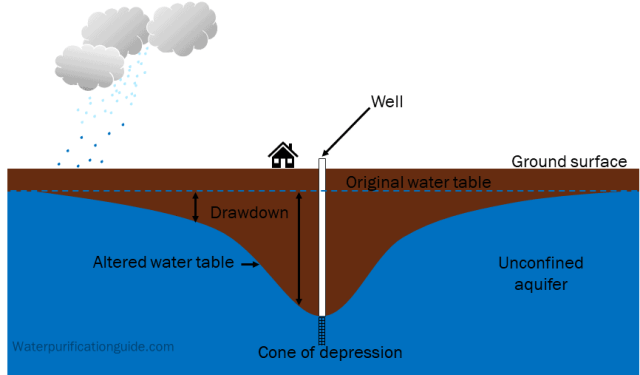
Both the cone of low and drawdown are not too much of an consequence if you merely have One well and your neighbors well isn't likewise shut to yours.
Basically if your pump rate is as well loftier, your well tin can dry up. Just if you dorsum the usage off and permit plenty time for the groundwater to migrate dorsum into the emptied pore spaces, yous shouldn't have a trouble.
However, they can become a problem if wells are located relatively close to each other.
How shut?
Well, it depends on many things such every bit:
- bedrock type
- aquifer connectivity
- pore sizes etc.
In my ain experience, I've recorded notable increases in drawdown depth and the cone of depression over a few miles from a well undergoing a pump examination. But there'south no reason to say the effects from a nearby well couldn't exist farther reaching than this. Once again, information technology really depends on your expanse.
Multiple wells: Issues with drawdown and the cone of low
If a well is relatively close to some other well (information technology could be yours or your neighbors), and so there is definite cause for concern as ane of them could start to run dry.
Here's why:
Changed groundwater catamenia direction
A large cone of depression can influence how groundwater moves underground and will often redirect water towards it. This means that a nearby well tin literally SUCK h2o abroad from yours causing the well water level to driblet or dry upwardly completely.
Water pumping is maintained for long periods of time
Well-nigh domestic wells are used for fairly short periods – either to fill up a reserve tank or when at that place is higher demand such every bit in the mornings or evenings when you're home.
In comparison, commercial wells (due east.g. for farming or mining) are typically run for much longer periods of time. The longer a well is pumped, the wider its influence on the groundwater system. Additionally, information technology can accept longer (sometimes weeks to months) for the area surrounding these heavily-used wells to recover meaning your well could remain low or dry for longer.
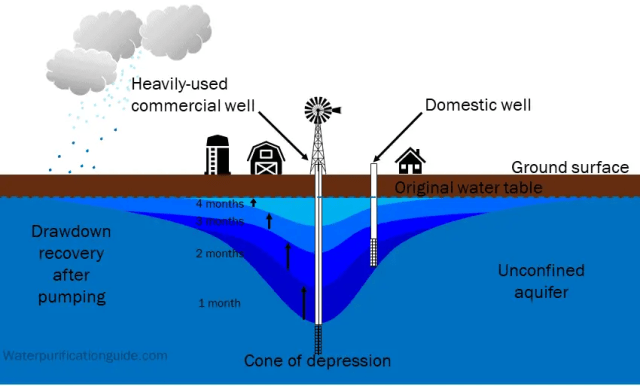
A nearby well is deeper
A deep well tin have a much larger cone of depression and deeper drawdown than a shallow well. Hmm, non good for whatever nearby wells. This can cause your well to dry up, prompting yous to consider drilling your ain well deeper or peradventure hydrofracking.
nine. Hydrofracking
Similar to drilling a deeper well, hydrofracking is a technique often used to increment a well'southward water production rate. Hydrofracking involves injecting very high-pressure water into the stone fabric surrounding your well. The process tin can help create new pathways for water to reach a well and increment its production.
All the same, if your neighbor does it and it dramatically increases how much water they can extract, it may not exist that bully for you. Over fourth dimension y'all may find a decrease in your well water level or it starts to run dry out from their increased apply.
Summary
So, I hope you got some helpful information from this post and you know what causes wells to go dry. Don't forget, yous should exist monitoring your well water height, full well depth and local rainfall patterns on a regular basis.
My recommended gear to practise the task properly includes:
- Best well dipper
- Best surveyors record mensurate
- Examination your well h2o
Delight feel free to use or share any of the images from this mail service, but please do u.s. the courtesy of citing www.waterpurificationguide.com every bit the source. Many thank you! 🙂


Source: https://waterpurificationguide.com/the-9-reasons-your-well-water-can-run-out/
Posted by: sosacolusay.blogspot.com
0 Response to "Why Does My Well Draw Down So Much?"
Post a Comment