

How To Draw Something Glowing With Colored Pencils
Painting Light with Colored Pencil
(Book Review)
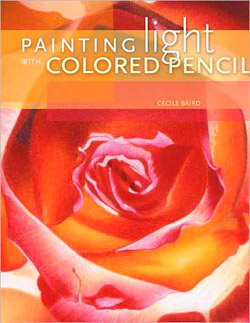
Painting Low-cal with Colored Pencil is a 128-page book of inspiration and instruction, showing yous how to create colored pencil drawings so rich in color they resemble oil paintings!
Colored pencils are a convenient medium for people seeking to achieve a high degree of realism in their art. The supplies needed are minimal, compared with many other mediums. Colored pencils create minimal mess and require little to no prep or clean-upwardly. Because colored pencils tin can be sharpened to a fine indicate, they are a natural medium for creating tight details.
Author Cecile Baird is an award-winning creative person who is well known in the colored pencil earth for her skill in creating luminous, highly realistic however life paintings using colored pencils. In her book, she shows you lot how to create realistic colored pencil paintings with an emphasis on capturing the special qualities of light and shadow to create rich, luminous works of art.
Read on for a detailed review of what yous'll find in Cecile Baird's Painting Calorie-free with Colored Pencil.
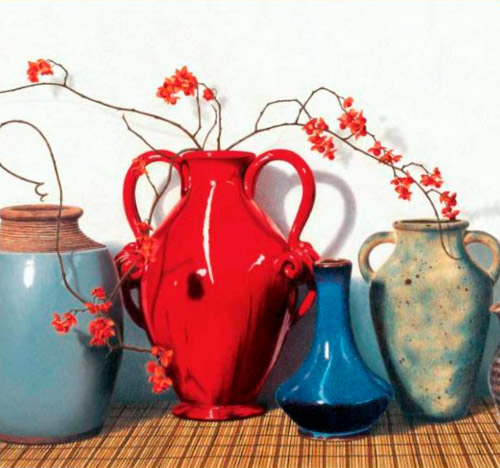
One of Cecile Baird's colored pencil yet life paintings, as seen in her book Painting Low-cal with Colored Pencil
Chapter one: Inspiration, Composition and Lighting
Painting Calorie-free with Colored Pencil begins with a 14-page intro chapter that covers a lot of useful information well-nigh setting up your still life, which is especially great info for beginners. Setting up a still life correctly is an essential part of the art-making process, because the whole strength of your drawing volition depend on the strength of your still life limerick.
Cecile encourages you to choose discipline matter that calls to you, and demonstrates how to set up successful still life compositions, keeping in mind factors such equally color, shape, repetition, texture, light, reflections, and shadows. She provides examples to illustrate each of these points.
She explains how to ready a good yet life composition, beingness aware of focal betoken, value, harmony, residual, betoken of view, and depth, with unlike examples to illustrate these points, explaining what works and what doesn't piece of work in each sample composition.
Lighting is another of import gene that deserves a lot of attention when setting up a still life. Lighting tin can affect your limerick by determining the effulgence of the highlights and depth of the shadows. You lot tin use artificial lighting or natural lighting. Natural lighting can modify quickly but if you photograph the all the same life then you don't demand to worry well-nigh the light irresolute while you're working on your cartoon. The utilise of bogus lighting is common when setting upwardly nevertheless lifes because it allows you to direct the lite but how you want it. Cecile includes a lot of handy tips, such as a reminder to utilise a single light source to get good highlights and shadows, rather than two competing light sources which will wash out the values.
There is also a section about photographing still lifes. This book was originally published in 2005 so it mentions picture photography, but these days most people use digital cameras. Cecile encourages y'all to have lots of photos of your composition, from different angles and with different lighting, which gives you a greater chance of coming upon the composition that is just correct.
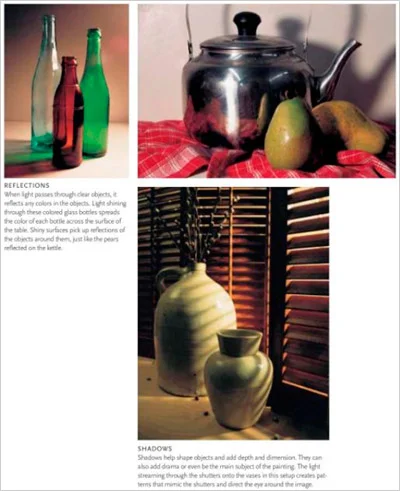
A lesson on setting up potent withal life compositions
Chapter 2: Tools and Techniques for Painting Light
This nineteen-page affiliate is packed with data. At present that y'all've learned how to prepare up your still life, yous're ready to go acquainted with your materials and learn basic colored pencil cartoon techniques. Chapter 2 starts with a discussion of paper, pencils and accessories.
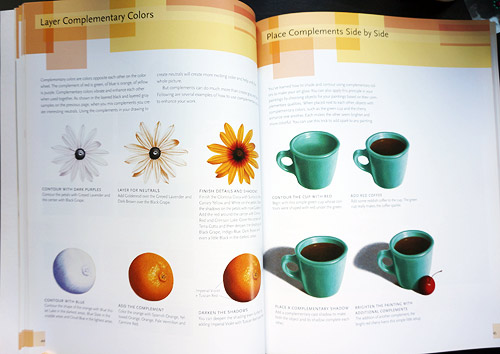
I of the sections in Affiliate two of Painting Calorie-free with Colored Pencil
When choosing paper to employ with colored pencils, you'll need to take into account the color, texture, heaviness/weight of the newspaper. Cecile lists her favorite paper for using with colored pencils.
There are three categories of colored pencils that are suitable for fine art: wax-based, oil-based, and water-soluble. Cecile describes her favorite colored pencils (Prismacolor) and provides an overview of several other brands and their qualities.
Cecile rounds out the word of supplies by explaining several accessories that come in handy for colored pencil artists, such as pencil storage / conveying instance, pencil carousel, pencil sharpeners, erasers, adjustable cartoon surface, desk brush, colorless blender, color lifters, solvent, glue, fixative and other tools.
Side by side the chapter moves forth to discuss techniques for transferring your photograph onto paper as a line drawing. The author describes 3 methods for creating a line drawing from your photo: the grid method, the projector method, and the copier method. She recommends drawing onto tracing paper so every bit not to ruin your concluding paper, and then transferring that drawing onto your final paper using either a lightbox, transfer paper.
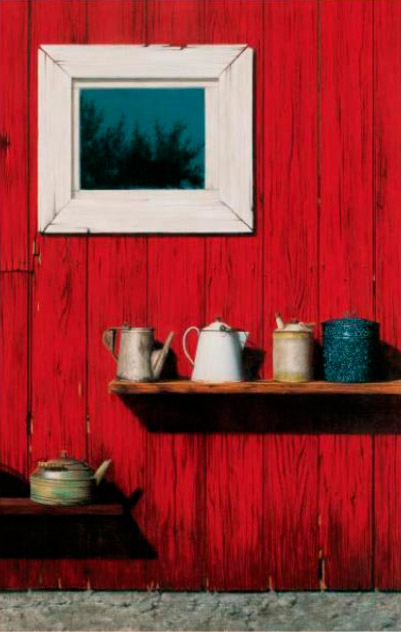
One of the examples of Cecile Baird'due south colored pencil art, shown in her book Painting Light with Colored Pencil
When you photograph your withal life composition, the camera may distort the paradigm in some ways. When you transfer your drawing, you may need to brand some corrections to the perspective and composition to compensate for any camera distortions. Cecile includes before and after images to illustrate her points nearly correcting perspective and limerick.
Now the colored pencil instruction begins. Cecile shows you different types of pencil strokes: circular, linear, and multidirectional. She explains why information technology'southward of import to keep your colored pencils precipitous, and describes iii types of pencil points, how they differ and what each 1 is for. She covers the importance of pencil pressure level and saturation indicate. She demonstrates three different burnishing techniques, with visual examples, and discusses the "wax bloom" miracle. This is excellent info for beginning colored pencil artists, because it sets the foundation for all your drawings.
This chapter also covers the use of solvents. When you utilise a solvent to dissolve and spread the color, you lot can quickly make full an surface area with color. Solvents can also alloy colors so that the color of the paper is no longer seen in between the paint marks. Cecile cautions you to practice using solvents before trying them on one of your colored pencil paintings, considering using too much solvent can remove color.
Next, Cecile covers the concepts of value and color. Y'all'll acquire how to run into values and how to draw value scales. She also shows you lot how to analyze the colors in your reference photo, and lists the colors she consistently uses. You'll learn how complementary colors can enhance 1 another when placed next to each other or layered on top of one some other. In that location is also an overview of how layering with colored pencils can create luminosity, resulting in rich, compelling colors. Since colored pencils are semi-transparent, they tin exist layered in limitless ways to create interesting hues.
Chapter 3: Create Fruit and Flowers That Glow
Affiliate iii is when the step-past-step demonstrations begin. For each demo, the author lists the specific colored pencils she uses (the brand names and colors).
In this chapter, Cecile explores how the use and placement of calorie-free tin can make fruit and flowers glow, resulting in radiant still lifes.
The step by step demos include:
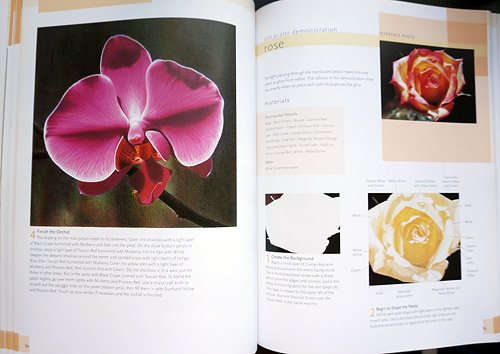
On the left you can run across her finished colored pencil painting of an orchid - hard to believe that's not a photo! On the correct you can see the begining of her rose lesson.
-
Kiwi fruit - back-lit with strong shadows
-
Juicy cantaloupe - you'll examine and identify color variations in an object that appears by and large monochromatic
-
Apple with crock - larn how to render two different shiny surfaces with full range of values, plus capture the cogitating calorie-free of the apple on the crock
-
Money plant - learn to capture light coming through the transparent leaves, and how to exercise a still life with a night groundwork
-
Rose - This lesson pinpoints which specific colors to put where to create the inner glow of the petals, which colors to use for defining the petals, and which colors to burnish with and the last colors to enhance with. Having these colors specifically pointed to in the progress images is very handy, and it's a feature that is lacking in the other demos.
-
Orchid
-
Autumn Leaves
-
Shiny green leaf
Chapter 4: Capture Light and H2o
In this chapter, yous'll learn how to capture the glow of calorie-free, the intricacy of reflections and the transparency of water.
The pace-by-footstep demos include:
-
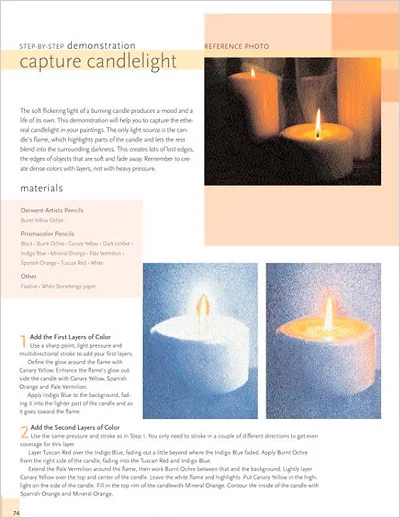
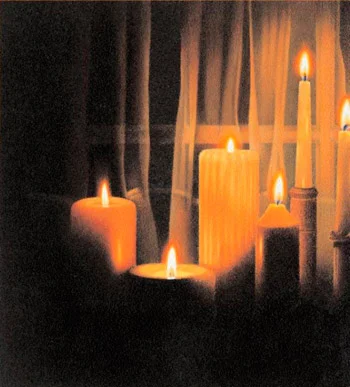
Candlelight - a still life where the merely light source is the candle's flame, which creates soft, faded edges between the candle and the background
-
Oil lamp - tackles both soft candlelight and glass reflections
-
Cobalt blue glass - create a variety of dejection and sharp shadow
-
Spilled h2o - chief the transparent and reflective qualities of water
-
Water fountain - tackle the characteristics of moving water
Chapter five: Bring Textures to Life
Capturing texture is an important attribute of drawing realistic notwithstanding lifes. Chapter 5 shows you how to capture a variety of textures, such as:
-
Copper cup - discover how the shiny surface is made upwardly of reflections of its surround
-
Cast iron kettle - a ho-hum and dark object with low contrast
-
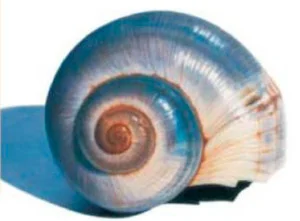
Freshwater vanquish - a shine surface with a spiral shape
-
Linen tablecloth - rough weave
-
Weathered wood box
-
Velvet drape
Affiliate half-dozen: Paint the Total Picture
In this final chapter of Painting Light with Colored Pencil, author Cecile Baird shows you how to necktie all the previous techniques together to create more circuitous nevertheless lifes. This chapter contains just ii demos merely they are quite in-depth (10 and 12 pages, respectively).
Stride-by-step colored pencil demos:
-
Combine textures in soft low-cal: Capture a wide range of values, textures and subjects
-
Pigment light-filled surfaces with texture: Depict a variety of vases of unlike colors and textures atop a bamboo mat
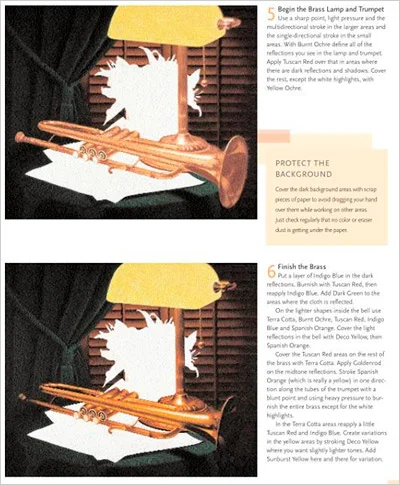
A page from i of Cecile Baird'southward final lessons in Painting Calorie-free with Colored Pencil
Conclusion
As you flip through Painting Low-cal with Colored Pencil, you lot tin can easily run into that Cecile Baird is a master of colored pencil techniques. Her beautiful art serves as inspiring examples throughout the volume of what can be accomplished with this medium.
Painting Light with Colored Pencil contains lots of demos, along with aplenty introductory material to get you going. For colored pencil artists who want to achieve this manner of realism in their still life art, this book volition exist a wonderful guide.
Who is this book for?
Painting Lite with Colored Pencil is a bully resources for anyone who wants to learn to create realistic still lifes using colored pencils. This book is so full of tips and information that even advanced colored pencil artists may learn something new.
Beginners will capeesh the introductory material, although total beginners might experience a footling overwhelmed by the demos, because about of the demos practice not pinpoint what colors to put where (the explanation of what colors to put where is commonly described in words, without arrows pointing to the actual cartoon, which can exist a bit challenging to follow). Beginners who can experience comfortable taking charge and practicing the techniques even if they're feeling unsure of where exactly to identify certain colors will benefit from the info in this book, although beginners who need more guidance might feel lost. Intermediate colored pencil artists will probably feel more comfortable post-obit along with these lessons.
If beginners feel lost, they can take note of the specific colors Cecile uses in each phase of a item demo and practise using those colors to reach similar results, without worrying most copying her artwork exactly. As she notes at the end of the book, "the goal is non necessarily for you to copy these paintings exactly as they appear here. Your goal is to master the techniques used to create these paintings. Then use these techniques for your own creations."
Who is this book not for?
If you are a total beginner to cartoon in general and yous are seeking pedagogy on basic cartoon techniques, Painting Light with Colored Pencil volition not be the book for you at this stage in your creative journey, because this book is focused on a specific media - colored pencils - and teaches techniques for achieving realism in that medium only, rather than basic cartoon principles.
If you are not interested in drawing realistic still lifes, then this volume is non for you, because information technology only focuses on notwithstanding lifes and only aims for realism (rather than expressionism, impressionism, whimsical, etc).
If you desire to draw portraits or landscapes in colored pencils, you would be able to adapt the techniques y'all learn from this volume to other subject field thing, but you might prefer to get a book that focuses on your desired subject matter every bit information technology would exist more than straight useful to you.
Advanced artists will probably know nigh of the techniques described in this book, although you may pick upwards a tip or technique or 2. This book is more ideal for beginners and intermediate colored pencil artists.
Where to Purchase
If you're interested in purchasing Painting Light with Colored Pencil, you can find it at Amazon via the link below
Every bit an Amazon Associate I earn from qualifying purchases.
- Amazon - eligible for Amazon Prime or FREE Super Saver Aircraft. Click hither to see this volume on Amazon.
A complimentary copy of Painting Light with Colored Pencil was provided to me by N Calorie-free Books for this review, which is based on my honest assessment of the volume. All images in this review are displayed with permission and are copyrighted by their respective owners.

Source: https://www.art-is-fun.com/painting-light-with-colored-pencil
Posted by: sosacolusay.blogspot.com
0 Response to "How To Draw Something Glowing With Colored Pencils"
Post a Comment